The Voiala project

A long-term environmental, economic and social project, run with rural communities in Madagascar since 2005.

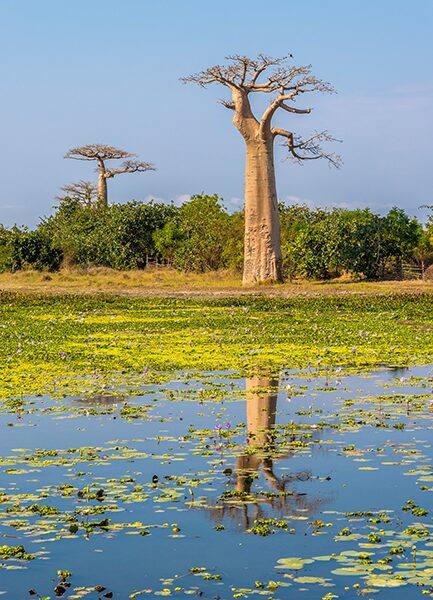
Tall baobab rising above green vegetation, reflected in a pond covered with water lilies
Specimen
A baobab reflected in a pond
Loc.
Madagascar
Note
Source: Favini

Why Madagascar

Madagascar is the world’s fourth-largest island, in the Indian Ocean off the south-east coast of Africa.

Its rainforest has been almost entirely destroyed. Without trees, the soil wears out, native plants and animals disappear and the land dries up into desert.

The island’s resources have been exploited for more than 2,000 years. The country has signed many international agreements to protect its environment, but they are not always easy to enforce.

What is destroying the forest

Industrial agriculture
Coffee above all, which keeps spreading because it sells at a high price. Source: Favini
Charcoal
The local custom of using charcoal made from felled trees as fuel. Source: Favini
Cattle farming
Introduced over 1,000 years ago, it has grown considerably in recent times. Source: Favini
Land clearing
On the ground, the report describes excessive logging, degraded forest and clearing for charcoal production. Source: Report Jul–Dec 2025

Living on worn-out land

2.9 % a year
population growth
9 in 10 people
live on less than 2 dollars a day, according to Favini

GDP per head remains one of the lowest in the world. In the villages, the report also notes little awareness that plant species are disappearing, and little reforestation followed through over time.

Background figures quoted by Favini, without a reference year.

Voiala, since 2005

Voiala works on two fronts. One is replanting parts of the lost forest. The other is raising awareness and training local people, mostly maize and peanut farmers, so they can improve how they farm.

Sahavondronina was chosen because the hills around the village had suffered extreme deforestation and the nearby fields had become barren.

There, the forest is protected through tree-planting and ecotourism. The goal is a more sustainable way of farming that respects the forest and local ecosystems, and that other communities can follow.

What the project sets out to do

  • Reforest the bare hills with local species.
  • Train farmers in more sustainable practices that respect the forest.
  • Protect the more than 2,077 ha of virgin forest around Sahavondronina.
  • Develop ecotourism in the area.
  • Improve living standards, and become a model for other communities.
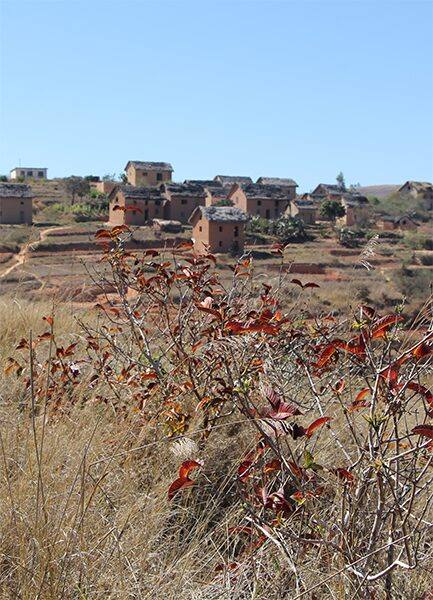
Red-brick multi-storey houses on a hillside, above red-leaved shrubs and dry grass

2005project begins

2,077 haof virgin forest to protect

7 communitiesin beekeeping

Specimen
Voiala project
Loc.
Sahavondronina, Androy
Date
since 2005
Leg.
communities of Sahavondronina
Note
Heavily deforested hills and barren fields before the project began. Source: Favini

Where the project works

The two sources name different places, each for what it describes. Here they are, with their scope.

Sahavondronina
The village at the heart of the project as described by Favini, which places it in Androy District. Over 2,077 ha of virgin forest surround it. In 2025 it hosts one of the project’s three nurseries.Source: Favini; Report Jul–Dec 2025
Manamisoa
Rural municipality where a local sustainable development agreement was drawn up with residents. It has the largest nursery of 2025 and an irrigation motor pump.Source: Report Jul–Dec 2025
Androy
Rural municipality in Lalangina District, Haute Matsiatra Region. Local sustainable development agreement, a nursery, and three community-based organisations (VOI) whose expired management contracts were updated in 2025.Source: Report Jul–Dec 2025
Ambatolahitelo
Third nursery site in 2025.Source: Report Jul–Dec 2025
Andranovorivato
Rural municipality where an irrigation motor pump was installed and tested at Andoharena in October 2025.Source: Report Jul–Dec 2025
Alakamisy Ambohimaha
Rural municipality that hosted Terra Madre Day 2025.Source: Report Jul–Dec 2025
Fianarantsoa
Home of the association’s office, where the above-ground fish farming demonstration site is located.Source: Report Jul–Dec 2025

The 2025 report places the association’s work in the Haute Matsiatra Region.

How we work

Local people decide and manage. The association trains, supports and connects them with partners and the authorities.

Community nurseries

Local associations and residents run the nurseries through management committees, supervised by the technical services. Young people in particular are trained in participatory planning and nursery management.
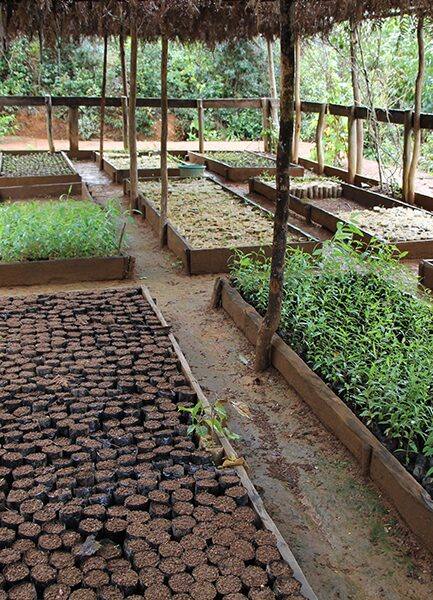
Nursery under a wooden shade house: seed beds and long rows of soil-filled pots
Nursery of seedlings for reforestation
Specimen
Community nurseries
Loc.
Manamisoa, Sahavondronina, Ambatolahitelo
Date
2025
Leg.
local management committees
Note
Three geolocated nurseries.

A local sustainable development agreement

It was drawn up in a participatory, inclusive way with the communities of the rural municipality of Manamisoa and of Androy. It sets the framework in which everyone replants and protects.

Specimen
Local sustainable development agreement
Loc.
Manamisoa; Androy
Leg.
local communities
Note
Drawn up in a participatory, inclusive way.

Forests entrusted to community organisations

In Madagascar, a community-based organisation, or VOI (Vondron’olona Ifotony), can be given the management of natural resources such as a forest under contract: this is called a management transfer (TGRN). Voiala works to restore and sustainably manage these areas in its third phase (2025–2028).

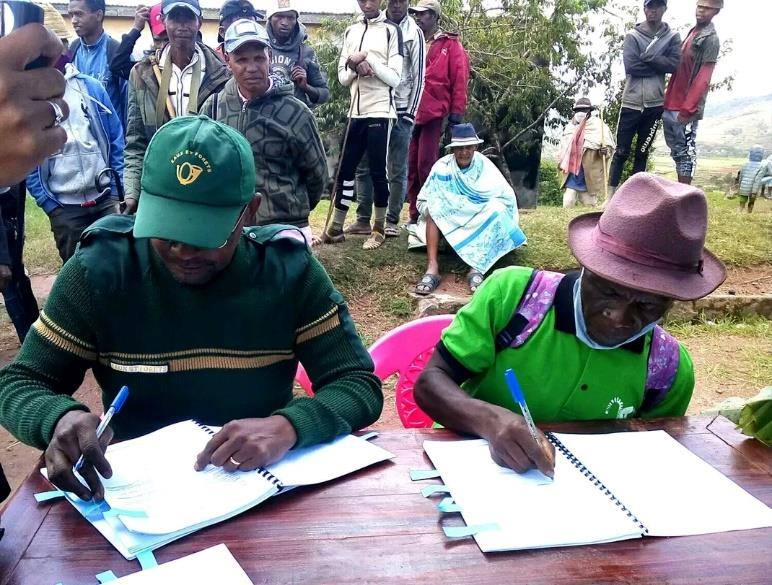
Two men seated at an outdoor table signing documents, with a crowd standing behind them
The regional director of Sustainable Development (left) and the community association president signing the management contract, rural commune of Androy
Specimen
Management transfers (VOI)
Loc.
Lalangina District, Haute Matsiatra Region
Date
phase 3, 2025–2028
Leg.
VOI 3FT, VOI Analasoa, VOI Analameva
Note
Traditional management transfer ritual held in December 2025.